
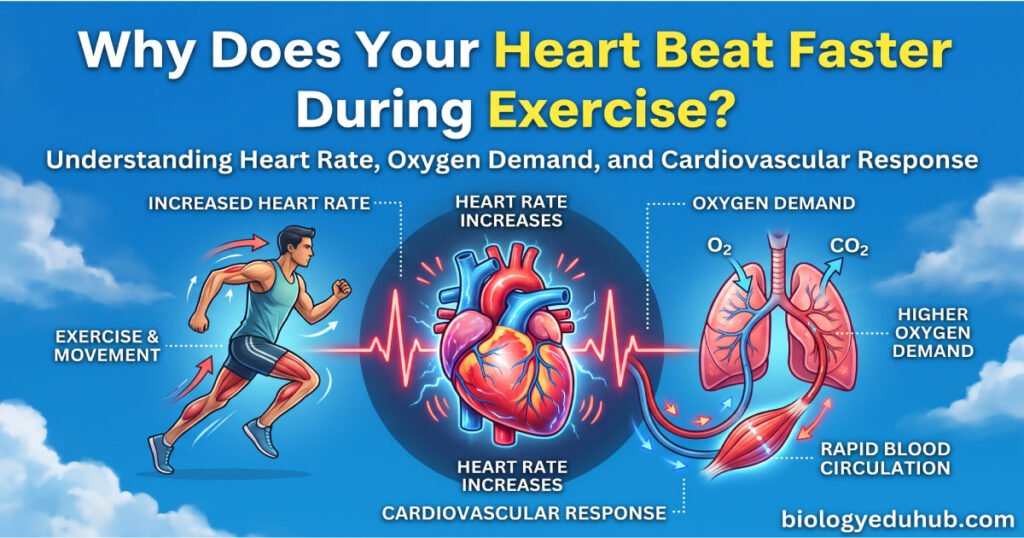
Your heart beats faster during exercise because your muscles need more oxygen and nutrients to produce energy. To meet this increased demand, your cardiovascular system works harder by increasing heart rate and the amount of blood pumped with each heartbeat. This allows oxygen-rich blood to reach active muscles more efficiently while helping transport carbon dioxide and other metabolic waste products away from tissues.
Whether you are walking, running, cycling, swimming, or lifting weights, your heart continuously adjusts its activity to match your body’s physical demands. This is a normal and essential physiological response that helps you exercise safely and efficiently.
Understanding why your heart beats faster during physical activity provides valuable insight into human anatomy, cardiovascular physiology, oxygen transport, and energy metabolism.
In this article, we will explore how exercise affects heart rate, how the nervous system controls the heartbeat, why muscles need more oxygen, and how the cardiovascular system adapts to regular physical activity.
What Is Heart Rate?
Heart rate is the number of times your heart beats in one minute. It is commonly measured in beats per minute (BPM).
The heart is a muscular organ located in the chest, slightly left of the body’s midline. Its primary function is to pump blood throughout the circulatory system, delivering oxygen and nutrients to tissues and carrying away metabolic waste products.
A person’s heart rate changes throughout the day depending on physical activity, emotional conditions, body temperature, medications, fitness level, and other physiological factors.
For most adults, a typical resting heart rate is approximately 60–100 beats per minute. However, well-trained athletes may have a lower resting heart rate because their hearts can pump an adequate amount of blood with fewer beats.
During exercise, heart rate normally increases because the body needs a greater supply of oxygen and nutrients.
Example:
- Sitting quietly: Your heart may beat around 60–80 times per minute.
- Walking briskly: Your heart rate generally increases to meet the muscles’ higher energy demands.
- Running: Your heart rate usually increases further.
- Intense exercise: Your heart may beat considerably faster, depending on exercise intensity, age, fitness, and other factors.
These values are examples rather than fixed targets. Individual responses vary.
Why Does Your Heart Beat Faster During Exercise?
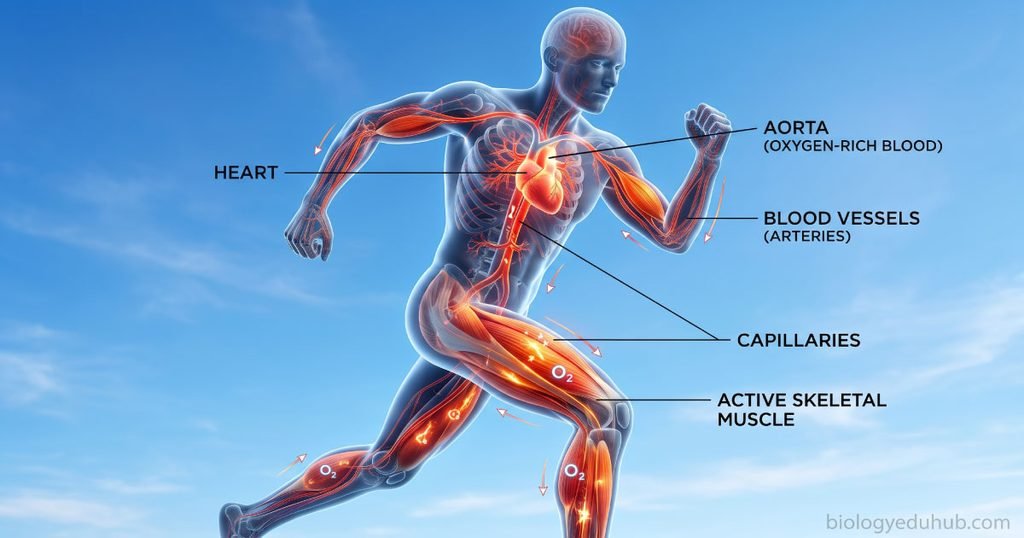
The primary reason your heart beats faster during exercise is that your working muscles require more energy than they do at rest.
Muscle cells produce much of their usable energy in the form of a molecule called adenosine triphosphate (ATP). During sustained physical activity, aerobic metabolism uses oxygen to help generate ATP efficiently.
As muscle activity increases, the demand for oxygen and nutrients rises. Your cardiovascular system responds by increasing blood circulation.
Several physiological processes work together to make this possible.
1. Working Muscles Require More Oxygen
During exercise, skeletal muscles contract repeatedly to produce movement. These contractions require ATP, which is continuously regenerated through cellular metabolic pathways.
During aerobic exercise, such as jogging, swimming, and cycling, muscle cells increase their use of oxygen to support energy production.
Oxygen is delivered to muscles through the bloodstream. Hemoglobin, a protein found in red blood cells, binds oxygen in the lungs and transports it to body tissues.
When exercise begins, the active muscles extract more oxygen from the blood and increase their blood flow.
To support this increased oxygen delivery, your heart pumps blood more rapidly.
2. The Heart Increases Cardiac Output
One of the most important reasons your heart beats faster during exercise is the increase in cardiac output.
Cardiac output is the total volume of blood pumped by one ventricle of the heart in one minute.
It depends on two major factors:
- Heart rate: The number of heartbeats per minute.
- Stroke volume: The amount of blood pumped by one ventricle during each heartbeat.
The relationship is expressed using this equation:
\[ \text{Cardiac Output} = \text{Heart Rate} \times \text{Stroke Volume} \]
For example, if your heart beats 70 times per minute and pumps 70 milliliters of blood per beat:
\[ 70 \times 70 = 4,900 \text{ mL/min} \]
That equals approximately 4.9 liters of blood per minute.
During exercise, both heart rate and stroke volume generally increase, allowing the heart to pump substantially more blood to active tissues.
This increased cardiac output helps meet the body’s greater metabolic requirements.
3. Your Nervous System Signals the Heart to Beat Faster
Your autonomic nervous system plays an essential role in regulating heart rate during exercise.
It has two major branches:
- Sympathetic nervous system
- Parasympathetic nervous system
These systems work together to control involuntary functions, including heartbeat, breathing, and blood vessel activity.
Sympathetic nervous system activation
When you begin exercising, sympathetic nervous system activity increases. This stimulates the heart through sympathetic nerve signals and the release of norepinephrine.
The adrenal glands can also release epinephrine (adrenaline) and norepinephrine into the bloodstream.
These chemicals act on beta-1 adrenergic receptors in the heart, increasing the rate of the heart’s pacemaker activity and generally increasing the force of contraction.
Reduced parasympathetic activity
At the same time, parasympathetic influence on the heart decreases, particularly through the vagus nerve.
This reduction removes some of the normal braking effect on the heart, allowing the heart rate to rise.
Together, these responses help your heart adjust rapidly to increased physical activity.
4. Blood Flow Increases Toward Active Muscles
During exercise, your body changes how blood is distributed.
Active skeletal muscles require more oxygen, glucose, fatty acids, and other nutrients to support their increased metabolic activity.
Local chemical signals produced by working tissues help dilate blood vessels supplying those muscles.
This process is known as vasodilation.
As a result:
- More blood reaches active muscles.
- Oxygen delivery increases.
- Nutrients become more available.
- Carbon dioxide and metabolic byproducts are transported away more efficiently.
The cardiovascular system coordinates these changes by increasing cardiac output and adjusting vascular resistance.
5. Your Body Must Remove More Carbon Dioxide
Muscle cells produce carbon dioxide during aerobic metabolism.
As exercise intensity increases, carbon dioxide production generally increases as well.
Carbon dioxide enters the bloodstream and is transported to the lungs, primarily in the form of bicarbonate ions, with additional amounts dissolved in plasma and bound to hemoglobin.
The lungs then remove carbon dioxide when you exhale.
Your heart helps maintain this transport process by circulating blood between the working muscles and the lungs.
This is another reason cardiovascular activity increases during exercise.
What Happens to Your Heart Rate at Different Exercise Intensities?
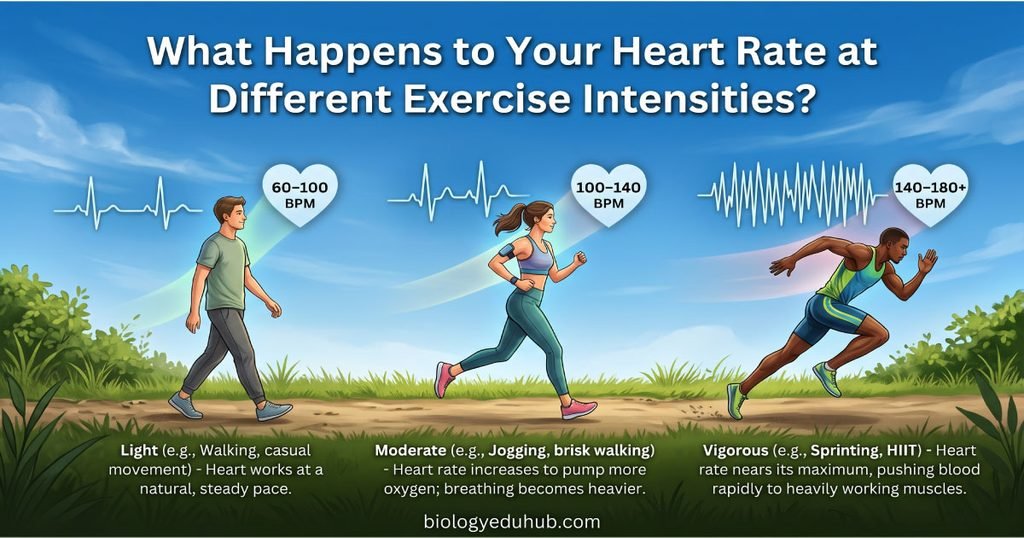
Your heart rate does not increase by the same amount during every type of physical activity. The response depends largely on how hard your muscles are working.
1. During Light Exercise
Activities such as slow walking, gentle cycling, and light stretching require relatively little additional energy.
Your heart rate increases slightly to provide extra blood flow to working muscles. Breathing may also become somewhat faster, but you can usually talk comfortably.
2. During Moderate Exercise
Activities such as brisk walking, recreational swimming, and cycling at a steady pace require more energy.
Your heart rate increases more noticeably. Your breathing becomes faster, and your cardiovascular system delivers more oxygen to working muscles.
3. During Vigorous Exercise
Activities such as running, fast cycling, and high-intensity interval training place greater demands on your cardiovascular system.
Your heart beats much faster, cardiac output increases substantially, and breathing becomes deeper and faster.
As exercise intensity approaches your maximum capacity, your heart rate approaches its individual maximum.
What Factors Affect Your Heart Rate During Exercise?
Although exercise increases heart rate in most people, the exact response varies from person to person.
Several factors influence how quickly and how much your heart rate increases.
Age
Maximum heart rate generally decreases with age. This means that a younger adult may reach a higher heart rate during intense exercise than an older adult.
An often-used estimate for maximum heart rate is:
\[ \text{Maximum Heart Rate} = 220 – \text{Age} \]
For example, for a 30-year-old adult:
\[ 220-30=190 \text{ BPM} \]
This is only a population-based estimate. Actual maximum heart rate can differ considerably between individuals.
Physical Fitness
People who exercise regularly often develop improved cardiovascular efficiency.
Their hearts may pump more blood with each contraction, meaning they can sometimes maintain the same exercise intensity with a lower heart rate than less-conditioned individuals.
Regular aerobic exercise can also improve oxygen delivery and the ability of muscles to extract and use oxygen.
Exercise Intensity
The harder you exercise, the greater your muscles’ energy requirements.
As exercise intensity increases, oxygen consumption generally rises, and heart rate usually increases to support the additional demand.
Body Temperature
During exercise, your muscles produce heat. Your body increases blood flow toward the skin and activates sweating to release excess heat.
Hot or humid conditions can increase cardiovascular strain, and heart rate may rise during prolonged exercise.
Hydration
Dehydration reduces the volume of circulating blood, which can make it harder for the cardiovascular system to maintain adequate circulation.
Your heart may compensate by beating faster, particularly during prolonged exercise in hot conditions.
Emotions and Stress
Anxiety, excitement, and emotional stress can activate the sympathetic nervous system.
This can increase heart rate even before physical activity begins.
Medications and Health Conditions
Certain medications, including beta-blockers, can reduce the heart rate response to exercise. Other medications and health conditions may increase or alter it.
People with cardiovascular conditions should follow individualized exercise guidance from their healthcare professionals.
Why Does Your Heart Rate Return to Normal After Exercise?

When you stop exercising, your muscles gradually require less oxygen and energy.
Consequently, the cardiovascular system begins returning toward its resting state.
Several physiological changes occur:
- Reduced sympathetic activity: Sympathetic stimulation of the heart decreases.
- Increased parasympathetic activity: The vagus nerve restores more of its normal influence on heart rate.
- Reduced oxygen demand: Working muscles require less oxygen as their activity decreases.
- Reduced cardiac output: The heart gradually pumps less blood per minute.
- Temperature regulation: Sweating and changes in skin blood flow continue helping the body cool down.
The time required for heart rate to recover depends on exercise intensity, fitness, age, hydration, temperature, and individual health.
Heart rate recovery is also used in exercise testing as one measure of cardiovascular and autonomic function.
A gradual cool-down after vigorous exercise can help the body transition from intense activity toward rest.
How Does Regular Exercise Make Your Heart Stronger?
Regular physical activity produces several beneficial cardiovascular adaptations.

Improved Stroke Volume
Regular aerobic training can increase the amount of blood pumped by the heart with each beat.
This is known as an increase in stroke volume.
As a result, a physically trained person may maintain an adequate cardiac output at rest with fewer heartbeats.
Improved Oxygen Delivery
Regular exercise improves the cardiovascular system’s ability to deliver oxygen to working muscles.
It can also increase the muscles’ ability to extract and use oxygen through adaptations such as increased mitochondrial capacity and capillary density.
Lower Resting Heart Rate
Some people who participate in regular aerobic exercise develop a lower resting heart rate.
This adaptation reflects changes in autonomic regulation and cardiovascular function, although individual responses vary.
Better Cardiovascular Health
Regular physical activity can help improve blood pressure, insulin sensitivity, blood lipid profiles, and overall cardiovascular fitness.
According to the American Heart Association, adults should generally aim for at least 150 minutes of moderate-intensity aerobic activity or 75 minutes of vigorous-intensity aerobic activity each week, or an equivalent combination. Muscle-strengthening activities are also recommended on at least two days per week.
Is It Normal for Your Heart to Beat Very Fast During Exercise?
Yes. An increase in heart rate during physical activity is a normal physiological response.
However, an unusually rapid, irregular, or uncomfortable heartbeat should not automatically be considered a normal exercise response.
Pay attention to warning signs, including:
- Chest pain or pressure.
- Unusual shortness of breath.
- Dizziness or fainting.
- A sudden racing or irregular heartbeat.
- Unusual weakness or severe fatigue.
Stop exercising if these symptoms occur. Chest discomfort, fainting, or severe breathing difficulty warrants immediate medical evaluation; call 911 in the United States for potentially serious symptoms.
People with known heart conditions, a history of abnormal heart rhythms, or other medical concerns should discuss appropriate exercise intensity with a healthcare professional.
How Can You Monitor Your Heart Rate During Exercise?
Monitoring your heart rate can help you understand how your body responds to physical activity.
You can measure it using:
- A smartwatch or fitness tracker.
- A chest-strap heart rate monitor.
- Manual pulse measurement at your wrist.
The American Heart Association provides general target heart rate estimates based on age.
For many adults, moderate-intensity exercise corresponds approximately to 50–70% of estimated maximum heart rate, while vigorous exercise corresponds approximately to 70–85%.
These percentages are general guidelines, not universal medical limits. Medication use, medical conditions, and individual fitness can change appropriate exercise targets. American Heart Association+1
Frequently Asked Questions (FAQs)
1. Why does my heart beat faster when I run?
Running increases the energy requirements of your skeletal muscles. Your heart beats faster to increase cardiac output and deliver more oxygen and nutrients to active muscles.
2. Does a faster heartbeat mean I am burning more calories?
A higher heart rate often accompanies increased energy expenditure during exercise, but heart rate alone cannot accurately determine calorie consumption. Exercise type, body size, fitness, and individual physiology also matter.
3. Why does my heart beat faster even during light exercise?
Your heart rate response depends on your fitness level, age, hydration, temperature, stress, medications, and health. Even relatively light activity can increase heart rate.
4. Why does my heart keep beating fast after I stop exercising?
Your body needs time to reduce its metabolic demands, restore normal temperature, and return cardiovascular activity toward resting levels. Heart rate generally decreases during recovery.
5. Do athletes have lower heart rates during exercise?
Not necessarily at the same absolute exercise intensity or maximum effort. Trained athletes often have lower resting heart rates and may have lower heart rates at a given submaximal workload. However, their maximum heart rates are not necessarily higher.
6. Can exercise improve heart health?
Yes. Regular physical activity can improve cardiovascular fitness, support healthy blood pressure, and reduce the risk of several chronic diseases.
7. Which part of the nervous system increases heart rate during exercise?
The sympathetic nervous system increases heart rate through sympathetic nerve activity and catecholamines. At the same time, reduced parasympathetic activity removes some of the heart’s normal inhibitory influence.
Conclusion: Why Does Your Heart Beat Faster During Exercise?
Your heart beats faster during exercise because your muscles need more oxygen and nutrients to produce the energy required for movement. To meet this increased demand, the cardiovascular system increases cardiac output through changes in heart rate and stroke volume.
The autonomic nervous system coordinates this response by increasing sympathetic activity and reducing parasympathetic influence on the heart. Blood flow also increases toward active muscles, allowing oxygen delivery and carbon dioxide removal to keep pace with changing metabolic demands.
Regular physical activity can improve cardiovascular efficiency, increase stroke volume, support healthy blood pressure, and improve overall physical fitness.
Therefore, an increased heart rate during exercise is generally a normal and essential adaptation that helps your body perform physical activities effectively.
Understanding this process helps explain how the heart, lungs, blood vessels, muscles, and nervous system work together to maintain the body’s energy requirements.
References and Scientific Sources
The following authoritative and scientific resources support the physiological explanations in this article.
1. American Heart Association (AHA). Target Heart Rates Chart.
Target Heart Rates During Exercise
2. National Center for Biotechnology Information (NCBI). Exercise Physiology.
Exercise Physiology – StatPearls
3. American Physiological Society (2023). Autonomic Cardiovascular Control During Exercise.
Autonomic Cardiovascular Control During Exercise – PMC
4. American Heart Association Journals. Exercise Standards for Testing and Training.
Cardiovascular Responses to Exercise
5. Advances in Physiology Education. The Pulmonary Physiology of Exercise.
The Pulmonary Physiology of Exercise
6. National Center for Biotechnology Information (NCBI). Physiology of Cardiac Output.
Physiology, Cardiac Output – StatPearls

[…] nervous system: Regulates many involuntary functions, including heart rate, digestion, glandular secretion, and smooth muscle […]