

Introduction
Have you ever wondered how you remember your first day at school, recognize a familiar face, or recall something you studied for an examination? Your brain performs these remarkable activities through a complex biological process called memory formation and storage.
Memory allows humans to learn from experiences, recognize people, develop skills, and make decisions. Although memories may feel like individual files stored inside the brain, they are actually represented by changing patterns of activity and connections among billions of nerve cells called neurons.
The human brain continuously receives information through the senses, processes important details, and changes its neural connections to preserve information for future use. Several brain regions work together during this process, particularly the hippocampus, cerebral cortex, and amygdala.
Understanding how your brain stores memories helps explain learning, forgetting, brain development, and certain neurological conditions. In this article, we explore the scientifically established mechanisms behind memory formation, consolidation, storage, and retrieval.
1. What Is Memory in the Human Brain?
Memory is the brain’s ability to encode, retain, and retrieve information over time.
In neuroscience, memory is generally divided into three major stages:
- Encoding: The brain receives and processes new information.
- Storage: Information is maintained through changes in neural activity and connections.
- Retrieval: The brain accesses previously learned information when needed.
For example, when a biology student learns about the human circulatory system, the brain first processes the information, establishes connections between relevant neurons, and later retrieves the learned information during an examination.
Memory is not stored in one specific location. Instead, different aspects of an experience are represented across interconnected neural networks.
2. How Do Neurons Help Store Memories?
Neurons are specialized nerve cells responsible for transmitting and processing information throughout the nervous system.
The human brain contains approximately 86 billion neurons. These cells communicate through specialized junctions called synapses.
A typical neuron has three major structural components:
- Dendrites: Receive signals from other neurons.
- Cell body (soma): Processes incoming signals and maintains cellular functions.
- Axon: Carries electrical impulses toward other cells.
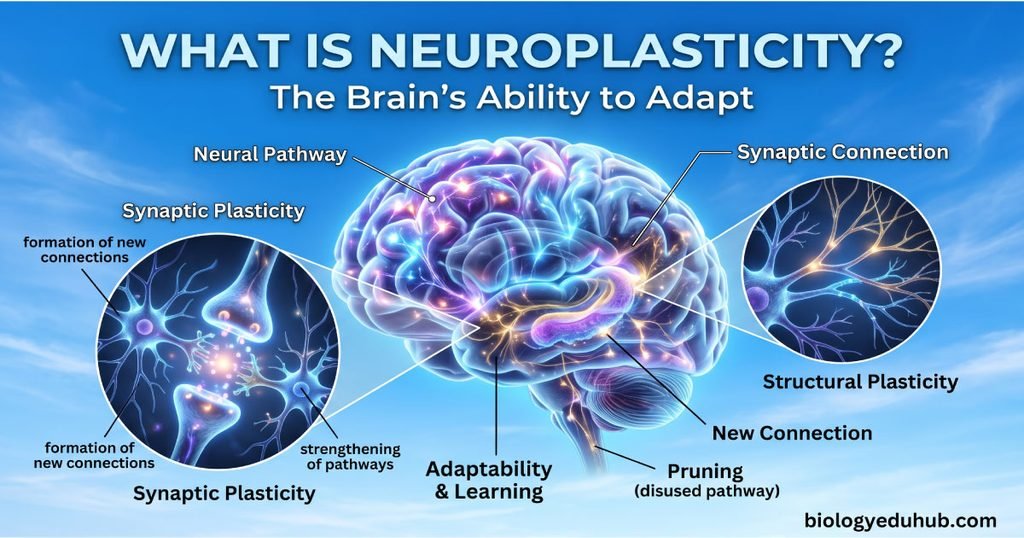
When you learn something new, groups of neurons become active in particular patterns. Communication between these neurons can become stronger or weaker depending on their activity.
These changes help establish neural networks that represent learned information.
For example, when you repeatedly practice remembering a scientific definition, the neural connections involved in processing and recalling that information can become more efficient.
This ability of the nervous system to modify its structure and function in response to experience is called neuroplasticity.
3. What Role Does the Hippocampus Play in Memory Formation?
The hippocampus is a small, curved structure located deep within the temporal lobes of the brain. It plays a crucial role in forming new memories, particularly memories of facts and personal experiences.
When you experience something new, information from different sensory and association-processing regions reaches the hippocampal system.
The hippocampus helps organize and bind these different elements into a coherent memory.
For example, remembering your first visit to a hospital may involve several details:
- The appearance of the building.
- The people you met.
- The sounds you heard.
- Your emotional experience.
- The events that occurred.
The hippocampus helps connect these different components so that the experience can later be remembered as a meaningful event.
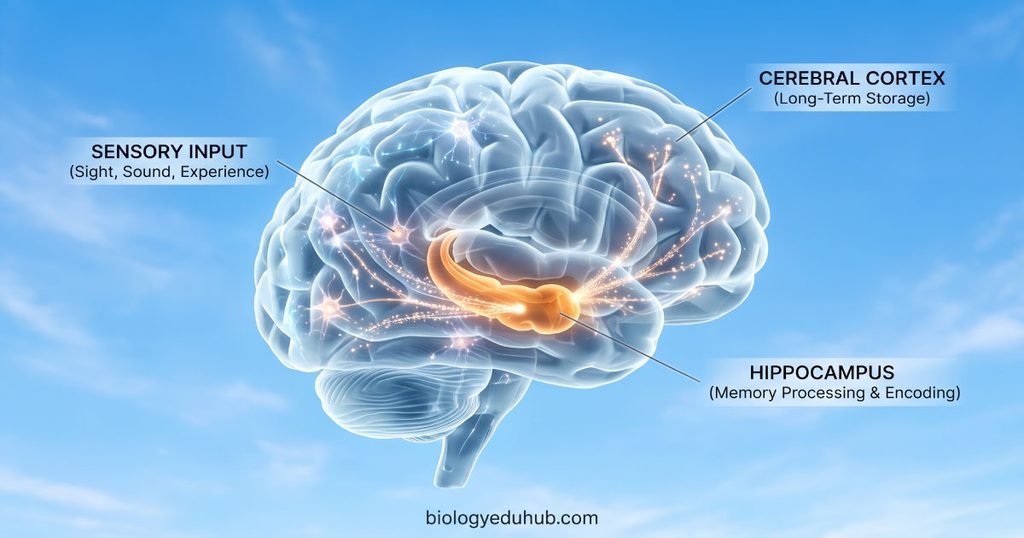
Image Showing the Role of Hippocampus in Memory Formation
An important distinction is that the hippocampus is essential for forming many new declarative memories, but it is not considered the permanent storage location for every long-term memory.
Damage to both hippocampi can severely impair the ability to form new conscious memories, a condition known as anterograde amnesia.
4. How Does Synaptic Plasticity Strengthen Memories?
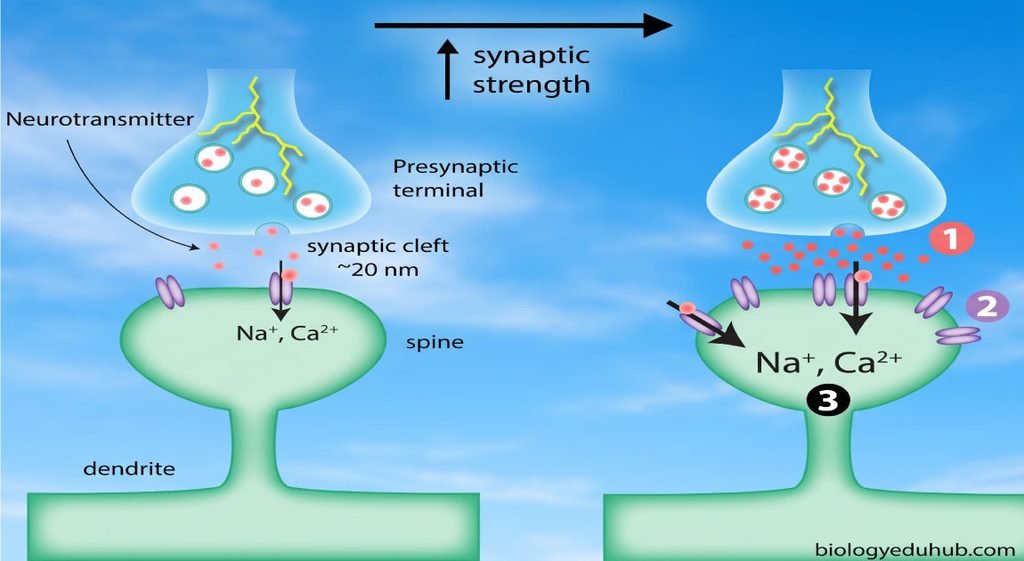
Image Showing the Role of Synaptic Plasticity Strengthen Memories
One of the most important biological mechanisms involved in memory formation is synaptic plasticity.
Synaptic plasticity refers to the ability of connections between neurons to change their strength over time.
One well-studied form is called long-term potentiation (LTP).
LTP is a persistent increase in the strength of communication between particular neurons following specific patterns of activity.
How does long-term potentiation work?
- An electrical signal reaches the presynaptic neuron.
- Neurotransmitters, particularly glutamate, are released into the synaptic space.
- Glutamate activates receptors on the postsynaptic neuron.
- Under appropriate conditions, NMDA receptors allow calcium ions to enter the postsynaptic cell.
- Calcium activates intracellular signaling pathways that can increase the number or effectiveness of AMPA receptors.
- Communication between the neurons becomes stronger.
These changes can make it easier for the same neural pathway to become activated again.
Long-term potentiation is especially well studied in the hippocampus and is considered an important cellular mechanism underlying certain forms of learning and memory.
However, memory formation involves several mechanisms, including changes in gene expression, protein synthesis, and neural network organization.
5. How Does the Brain Convert Short-Term Memories Into Long-Term Memories?
The brain does not preserve every piece of information permanently. Some information remains available for only a few seconds, while other information can be remembered for years or even throughout life.
Memory is commonly classified into different categories.
Short-term memory
Short-term memory temporarily maintains a limited amount of information for a brief period.
For example, remembering a telephone number long enough to dial it involves short-term memory.
Working memory
Working memory allows the brain to temporarily hold and manipulate information while performing mental activities.
For example, solving a mathematical problem requires keeping numbers and intermediate results in mind.
The prefrontal cortex and interconnected brain networks play important roles in working memory.
Long-term memory
Long-term memory preserves information over extended periods. It includes knowledge, personal experiences, learned skills, and habits.
Long-term memory can be divided into two important categories:
| Memory type | Description | Example |
|---|---|---|
| Declarative memory | Conscious memory of facts and events | Remembering the names of human bones |
| Procedural memory | Memory for learned skills and actions | Riding a bicycle or playing piano |
Declarative memory includes semantic memory (facts and knowledge) and episodic memory (personal experiences).
Procedural learning involves brain circuits that include the basal ganglia and cerebellum.
How does the transition happen?
When information is repeatedly processed and relevant neural connections undergo lasting changes, the memory may become more stable. This process involves synaptic consolidation, which occurs over hours and longer periods, and systems consolidation, which involves changes in communication between different brain regions.
6. Why Is Sleep Important for Storing Memories?
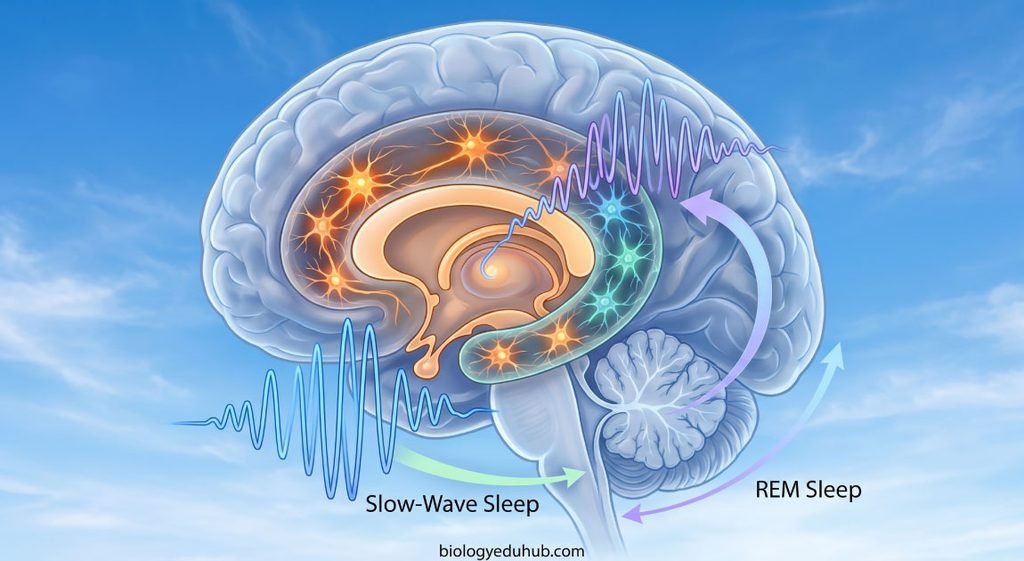
Image Showing Why Sleep is Important for Strong Memories
Sleep is essential for healthy brain function and plays an important role in memory consolidation.
Interestingly, your brain does not simply switch off when you fall asleep. It remains biologically active and participates in processing information acquired during waking hours.
During certain stages of sleep, particularly non-rapid eye movement (NREM) sleep, the brain exhibits coordinated patterns of electrical activity that support memory consolidation.
Three important processes are involved:
- Slow oscillations: Large-scale electrical rhythms associated with deep NREM sleep.
- Sleep spindles: Brief bursts of rhythmic brain activity generated through thalamocortical circuits.
- Hippocampal sharp-wave ripples: Short periods of synchronized neuronal activity associated with memory reactivation.
These processes help coordinate communication between the hippocampus and cerebral cortex.
During this activity, recently learned information may be reactivated and integrated into existing neural networks.
For example, a medical student who studies human anatomy during the day may benefit from adequate sleep because sleep supports the consolidation of newly acquired knowledge.
REM sleep also contributes to memory processing, particularly in certain forms of emotional and associative memory.
Importantly, memory consolidation is not simply the transfer of complete memories from one brain location to another. It involves complex interactions and changes across interconnected neural networks.
Research published in Nature Neuroscience describes how sleep-related neural activity supports the stabilization and reorganization of memories. Nature+2
7. What Is the Role of the Amygdala in Emotional Memories?
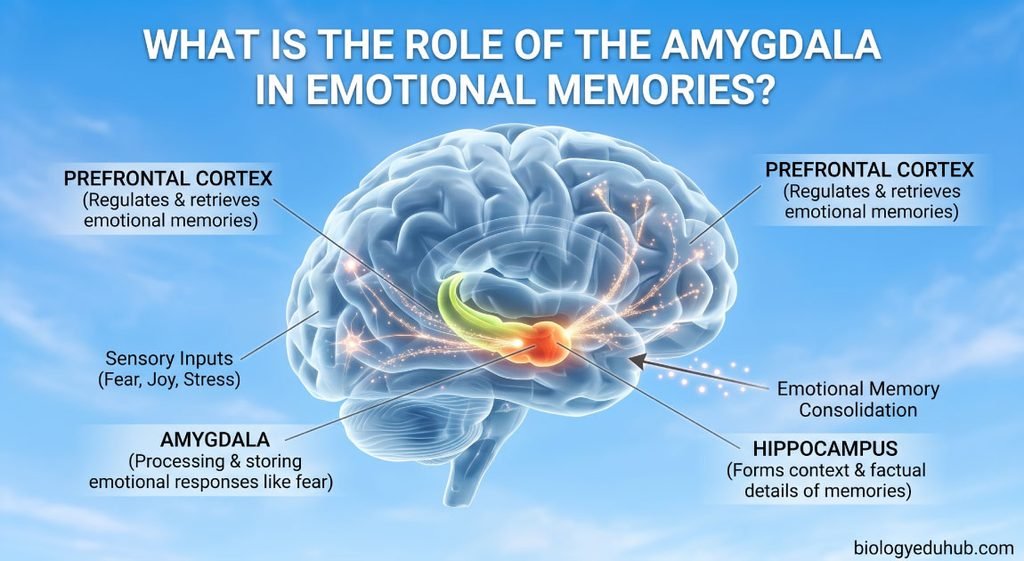
Image Showing the Role of the Amygdala in Emotional Memories
The amygdala is a group of almond-shaped structures located deep within the temporal lobes.
It plays an important role in processing emotions, especially fear and emotional significance.
When an experience involves strong emotions, the amygdala can influence memory formation by interacting with the hippocampus and other brain regions.
For example, people may remember emotionally significant experiences more vividly than ordinary daily activities.
Consider a person who narrowly avoids a car accident. The emotional intensity of the experience may influence how strongly certain details are remembered.
The stress hormones and neurotransmitters released during emotionally significant events can also influence memory processes.
However, emotional memories are not necessarily perfectly accurate. A person may strongly remember an event while forgetting or misremembering some details.
The amygdala therefore helps explain why emotional experiences can have a powerful influence on memory.
8. Where Are Long-Term Memories Stored in the Brain?
One of the most fascinating discoveries in neuroscience is that memories are not stored in a single memory center.
Instead, information is represented by interconnected groups of neurons distributed across different brain regions.
Scientists use the term memory engram to describe the physical and functional neural changes associated with a particular memory.
Different parts of an experience may involve different brain regions.
For example:
- The visual cortex processes visual information.
- The auditory cortex processes sounds.
- The somatosensory cortex processes touch-related information.
- The hippocampal system helps organize episodic memories.
- The prefrontal cortex contributes to memory organization, working memory, and retrieval.
During systems consolidation, interactions between the hippocampus and cortical networks help stabilize and reorganize certain memories over time.
Some remote memories become less dependent on the hippocampus, although the degree of hippocampal involvement varies with the type and detail of the memory.
Research into memory engrams has revealed that memory storage involves specific neuronal populations and changing connections rather than a single permanent physical location. Nature+2
9. How Does the Brain Retrieve Stored Memories?
Memory retrieval is the process of accessing previously learned information.
When you recognize a familiar face or remember a scientific concept, your brain activates neural networks associated with the original learning experience.
Retrieval often begins with a cue.
For example, seeing a photograph of your childhood home may activate associated memories involving family members, familiar surroundings, and past experiences.
The hippocampus helps reconstruct associations among different elements of episodic memories, while cortical regions contribute to the information being recalled.
Memory retrieval is not always a perfect reproduction of the original experience.
Instead, remembering can involve reconstructing information from different components of a stored memory.
This explains why details may change over time and why two people can remember the same event differently.
Another important concept is memory reconsolidation. When certain memories are reactivated, they can temporarily become susceptible to modification before being restabilized. This process is influenced by the nature and conditions of memory retrieval.
10. Why Do Humans Forget Memories?
Forgetting is a normal part of brain function. Although the brain has an impressive ability to retain information, not every experience becomes a permanent memory.
Several factors contribute to forgetting:
1. Memory interference: New information may interfere with previously learned information, or older information may make it harder to remember something new.
2. Weak memory encoding: Information that receives little attention or processing may not be stored effectively.
3. Lack of retrieval cues: Sometimes information remains available but is difficult to retrieve without appropriate reminders.
4. Insufficient sleep: Poor sleep can interfere with the consolidation of newly acquired memories.
5. Changes in neural connections: Synaptic connections can weaken or change over time, influencing the accessibility of stored information.
Forgetting does not always mean that a memory has been completely erased. Sometimes the information may still be represented in the brain but cannot be successfully retrieved.
Scientists continue to investigate the cellular and molecular mechanisms responsible for forgetting and memory persistence. Nature+1
11. How Can You Improve Memory and Learning?
Although memory depends on complex biological mechanisms, certain evidence-based learning habits can support better retention.
Here are some useful strategies for students and lifelong learners:
- Get sufficient sleep: Maintain a consistent sleep schedule to support learning and memory consolidation.
- Practice active recall: Try remembering information without looking at your notes.
- Use spaced repetition: Review information at gradually increasing intervals.
- Understand concepts: Connect new information with knowledge you already have.
- Exercise regularly: Physical activity supports overall brain health and cognitive function.
- Avoid distractions: Focused attention improves the initial encoding of information.
- Use meaningful examples: Connect scientific concepts with real-life experiences.
For medical and biology students, combining active recall with spaced repetition can be particularly useful when learning complex subjects such as anatomy, physiology, biochemistry, and neuroscience.
These strategies do not guarantee that every detail will be remembered, but they can improve learning efficiency and retention.
12. What Happens to Memory as the Brain Ages?
Memory abilities can change throughout life. During childhood and adolescence, the brain undergoes significant development, including changes in neural connectivity and synaptic organization.
In adulthood, the brain continues to adapt through neuroplasticity. Learning new skills, acquiring knowledge, and experiencing new environments can contribute to ongoing changes in neural networks.
As people grow older, certain aspects of memory may become less efficient. For example, older adults may experience greater difficulty recalling names, learning unfamiliar information quickly, or remembering details.
However, aging does not automatically mean that a person will develop serious memory problems.
Some forms of knowledge, vocabulary, and accumulated experience can remain relatively strong during healthy aging.
Neurological conditions such as Alzheimer’s disease can cause progressive damage to brain networks involved in memory and other cognitive functions.
Understanding the biological mechanisms of memory is therefore important for neuroscience, medical research, and the development of treatments for memory-related disorders.
Conclusion: How Does Your Brain Store Memories?
Your brain stores memories through complex changes in the activity, strength, and organization of interconnected neurons.
When you experience something new, neural networks become active and process the incoming information. The hippocampus helps organize many new declarative memories, while synaptic plasticity strengthens or modifies communication between neurons.
Through mechanisms such as long-term potentiation, changes in gene expression, and protein synthesis, neural connections can become more stable. Memory consolidation, supported by interactions between the hippocampus and cerebral cortex, helps maintain information over longer periods.
Sleep, emotional experiences, attention, and repeated learning also influence how memories are formed and retrieved.
Ultimately, memories are not stored like files on a computer. They are represented by dynamic patterns of activity and lasting biological changes across interconnected neural networks.
Understanding these mechanisms provides valuable insights into human learning, cognitive development, aging, and neurological diseases.
Frequently Asked Questions (FAQs)
1. How does the brain store memories permanently?
The brain maintains long-term memories through lasting changes in neural connections, neuronal activity, and interconnected brain networks. Synaptic plasticity and memory consolidation are important mechanisms involved in this process.
2. Which part of the brain is responsible for storing memories?
No single brain region stores all memories. The hippocampus is essential for forming many new declarative memories, while different cortical and subcortical regions contribute to long-term storage and different types of memory.
3. How do neurons create memories?
Neurons create memory-related changes by modifying their communication patterns and synaptic connections. Repeated or appropriately patterned activity can strengthen particular connections through mechanisms such as long-term potentiation.
4. Does sleep help the brain store memories?
Yes. Sleep supports memory consolidation through coordinated neural activity involving the hippocampus, thalamus, and cerebral cortex. Both NREM and REM sleep contribute to different aspects of memory processing.
5. How long can the human brain store a memory?
Memories can last from seconds to an entire lifetime. Their duration depends on factors such as the type of memory, learning experience, consolidation, retrieval, and changes in neural networks.
6. Why do we forget information?
Forgetting can occur because of weak initial encoding, interference from other information, insufficient retrieval cues, and changes in neural connections. It is a normal aspect of memory function.
7. What is a memory engram?
A memory engram refers to the group of neurons and associated biological changes that represent a particular memory. These neural populations can participate in memory encoding, consolidation, and retrieval.
References and Scientific Sources
The following peer-reviewed scientific publications provide further reading for medical and biology students.
1. Tonegawa, S., Morrissey, M. D., & Kitamura, T. (2018). The role of engram cells in the systems consolidation of memory. Nature Reviews Neuroscience, 19, 485–498. Read the research article.
2. Guskjolen, A., & Cembrowski, M. S. (2023). Engram neurons: Encoding, consolidation, retrieval, and forgetting of memory. Molecular Psychiatry, 28, 3207–3219. Read the full-text research review.
3. Klinzing, J. G., Niethard, N., & Born, J. (2019). Mechanisms of systems memory consolidation during sleep. Nature Neuroscience, 22, 1598–1610. Read the research article.
4. Choucry, A., Nomoto, M., & Inokuchi, K. (2024). Engram mechanisms of memory linking and identity. Nature Reviews Neuroscience, 25, 375–392. Read the research article.
5. Zaki, Y., & Cai, D. J. (2025). Memory engram stability and flexibility. Neuropsychopharmacology, 50, 285–293. Read the research article.
6. Lutz, N. D., Harkotte, M., & Born, J. (2026). Sleep’s contribution to memory formation. Physiological Reviews. Read the scientific review.
