
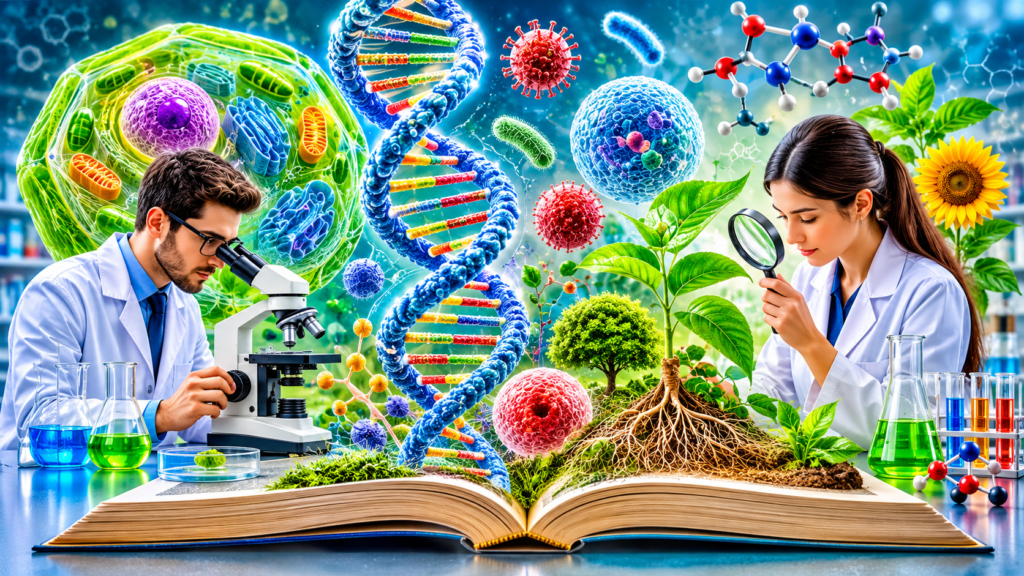
Introduction
Biology is one of the most important branches of science because it helps us understand life and living organisms. From microscopic bacteria to enormous whales, biology explores how living things grow, survive, reproduce, interact with their environments, and evolve over time.
Whether you are a student learning about cells, a healthcare professional studying the human body, or someone interested in nature, biology provides essential knowledge about the world around us.
In this guide, we will explore the definition of biology, its major branches, its importance in everyday life, and how it contributes to modern scientific discoveries.
What Is Biology?
Biology is the scientific study of life and living organisms. It examines the structure, function, growth, development, reproduction, evolution, and interactions of living things.
The word biology comes from two Greek words:
- Bios: Meaning life.
- Logos: Meaning study or knowledge.
Therefore, biology literally means the study of life.
Biologists study a wide variety of organisms, including humans, animals, plants, fungi, and microorganisms such as bacteria and some types of algae.
Biology also investigates how living organisms interact with one another and their surroundings. For example, it helps explain how plants produce food through photosynthesis, how the human immune system fights infections, and how animals adapt to changing environments.
Definition of Biology
Biology is the branch of natural science that studies living organisms, their structures, functions, growth, reproduction, evolution, and relationships with their environment.
This definition covers both microscopic life forms and complex organisms, including humans, plants, and animals.
Major Characteristics of Living Organisms
Living organisms share several fundamental characteristics that distinguish them from nonliving things.
1. Cellular Organization
All living organisms are made of one or more cells. Cells are the basic structural and functional units of life.
For example, bacteria consist of a single cell, while humans contain trillions of specialized cells.
2. Metabolism
Metabolism refers to all the chemical reactions that occur inside an organism to maintain life.
These reactions include processes that break down nutrients to release energy and processes that build molecules needed for growth and repair.
3. Growth and Development
Living organisms grow and undergo development during their life cycles.
For example, a seed develops into a plant, while a human baby grows into an adult.
4. Reproduction
Reproduction is the biological process through which organisms produce offspring.
It may occur sexually, involving the fusion of reproductive cells, or asexually, without the fusion of gametes.
5. Response to Stimuli
Living organisms respond to changes in their internal or external environments.
For example, a sunflower responds to light, and humans automatically withdraw their hands from painful heat.
6. Homeostasis
Homeostasis is the maintenance of relatively stable internal conditions despite changes in the external environment.
For example, the human body regulates its temperature to maintain normal physiological functioning.
7. Adaptation and Evolution
Populations of living organisms can develop inherited adaptations over generations through evolutionary processes.
These adaptations may improve survival and reproductive success in particular environments.
What Are the Main Branches of Biology?
Biology is a broad scientific discipline divided into several specialized branches. Each branch focuses on a particular aspect of life.
Here are some of the major branches of biology.
1. Botany
Botany is the scientific study of plants. It examines plant structure, growth, reproduction, classification, physiology, and ecology.
Botanists study trees, flowers, grasses, algae, and other plant organisms.
2. Zoology
Zoology is the branch of biology that studies animals.
It includes animal anatomy, physiology, behavior, reproduction, evolution, classification, and interactions with the environment.
3. Microbiology
Microbiology is the study of microorganisms, which are generally too small to be seen clearly without a microscope.
It includes the study of bacteria, archaea, microscopic fungi, protozoa, and viruses.
4. Genetics
Genetics is the study of genes, heredity, and variation in living organisms.
It explains how characteristics are passed from parents to offspring and how genetic information influences biological traits.
5. Ecology
Ecology is the scientific study of relationships between organisms and their living and nonliving environments.
Ecologists investigate ecosystems, food chains, biodiversity, populations, and environmental changes.
6. Anatomy
Anatomy is the study of the internal and external structures of organisms.
Human anatomy, for example, examines organs such as the heart, brain, lungs, kidneys, and digestive system.
7. Physiology
Physiology studies how living organisms and their parts function.
Human physiology explores processes such as blood circulation, breathing, digestion, nerve signaling, and hormone regulation.
8. Cell Biology
Cell biology focuses on the structure, function, and behavior of cells.
It examines cellular components such as the nucleus, mitochondria, cell membrane, ribosomes, and cytoplasm.
9. Molecular Biology
Molecular biology investigates biological processes at the molecular level, particularly the interactions involving DNA, RNA, and proteins.
It helps scientists understand how genetic information is stored, expressed, and regulated.
10. Evolutionary Biology
Evolutionary biology studies how populations and species change over generations.
It explores natural selection, genetic variation, common ancestry, and the origin and diversification of life.
11. Marine Biology
Marine biology is the study of organisms living in oceans and other saltwater environments.
Marine biologists study fish, corals, marine mammals, sea turtles, plankton, and ocean ecosystems.
12. Biotechnology
Biotechnology uses living organisms, cells, or biological molecules to develop useful products and technologies.
Applications include genetic engineering, medical diagnostics, vaccine development, and agricultural improvements.
Importance of Biology in Everyday Life
Biology plays an essential role in human life, scientific progress, environmental protection, and technological development.
Its importance extends far beyond classrooms and laboratories.
1. Understanding the Human Body
Biology helps us understand how the human body works.
It explains the functions of organs, tissues, cells, hormones, and organ systems. This knowledge is essential for understanding health, nutrition, physical development, and disease prevention.
2. Advancing Medicine and Healthcare
Biological research contributes to the development of medicines, vaccines, diagnostic tests, and medical treatments.
For example, knowledge of genetics, microbiology, immunology, and molecular biology helps researchers investigate diseases and develop new healthcare technologies.
3. Improving Agriculture
Biology helps farmers and agricultural scientists improve crop production and food quality.
Plant genetics, soil microbiology, plant physiology, and biotechnology contribute to developing disease-resistant crops and improving agricultural productivity.
4. Protecting the Environment
Ecology and environmental biology help scientists understand ecosystems, biodiversity, pollution, climate-related environmental changes, and conservation.
Biological knowledge supports efforts to protect endangered species, restore habitats, and maintain ecological balance.
5. Understanding Diseases
Biology helps explain how diseases develop, spread, and affect living organisms.
Microbiology, immunology, genetics, and pathology provide important knowledge for identifying infectious diseases, understanding inherited disorders, and developing preventive strategies.
6. Supporting Biotechnology
Modern biotechnology depends heavily on biological discoveries.
Scientists use biological knowledge to develop diagnostic technologies, genetically engineered organisms, therapeutic proteins, and other useful products.
7. Conserving Wildlife and Biodiversity
Biology helps scientists understand the diversity of life on Earth.
Research in zoology, botany, ecology, and conservation biology supports wildlife protection, habitat preservation, and the sustainable management of natural resources.
Different Levels of Biological Organization
Living organisms are organized into different levels, ranging from small chemical structures to the entire biosphere.
The main levels of biological organization are:
- Atoms: Basic units of chemical elements.
- Molecules: Groups of atoms bonded together, such as water and DNA.
- Organelles: Specialized structures within cells, such as mitochondria.
- Cells: The basic structural and functional units of life.
- Tissues: Groups of similar cells performing related functions.
- Organs: Structures made of different tissues working together.
- Organ Systems: Groups of organs coordinating specific functions.
- Organisms: Individual living things.
- Populations: Groups of organisms of the same species living in a particular area.
- Communities: Different populations living and interacting in an area.
- Ecosystems: Communities of organisms interacting with their physical environments.
- Biosphere: The global zone of Earth where life exists.
Understanding these levels helps students explore how biological structures and processes are connected.
Why Should Students Study Biology?
Biology is an important subject for students because it develops scientific knowledge and helps them understand life.
Some major benefits include:
- Scientific understanding: Students learn how living organisms function and interact.
- Health awareness: Biology provides knowledge about nutrition, diseases, hygiene, and the human body.
- Environmental awareness: It encourages the protection of ecosystems and biodiversity.
- Critical thinking: Biological studies develop observation, investigation, and problem-solving skills.
- Career opportunities: Biology provides a foundation for careers in medicine, healthcare, biotechnology, agriculture, research, and environmental science.
Students interested in becoming doctors, nurses, pharmacists, veterinarians, microbiologists, or research scientists can benefit from studying biology.
Frequently Asked Questions About Biology
1. What is biology in simple words?
Biology is the scientific study of life and living organisms, including humans, animals, plants, and microorganisms.
2. Who is known as the Father of Biology?
Aristotle is widely known as the Father of Biology because of his early systematic studies and observations of animals and living organisms.
3. What are the three major branches of biology?
Botany, zoology, and microbiology are three major branches of biology. They focus on plants, animals, and microorganisms, respectively.
4. What are the five major characteristics of living organisms?
Five important characteristics are cellular organization, metabolism, growth and development, reproduction, and response to stimuli. Homeostasis and adaptation are also fundamental biological concepts.
5. Why is biology important in medicine?
Biology helps medical researchers understand the human body, identify disease mechanisms, develop medicines, create vaccines, and improve diagnostic methods.
6. What is the difference between biology and chemistry?
Biology primarily studies living organisms and life processes, while chemistry studies the composition, properties, structure, and reactions of matter. Both sciences are closely connected because biological processes depend on chemical reactions.
7. What careers can students pursue after studying biology?
Students with a background in biology may pursue careers in medicine, nursing, pharmacy, veterinary science, biotechnology, microbiology, genetics, environmental science, and biological research, depending on their education and qualifications.
Conclusion
Biology is the scientific foundation for understanding life and the natural world. It explores everything from the smallest cellular structures to complex ecosystems and the interactions among living organisms.
Its major branches, including botany, zoology, microbiology, genetics, ecology, and molecular biology, contribute to advances in medicine, agriculture, biotechnology, and environmental conservation.
Studying biology not only improves scientific knowledge but also helps people make informed decisions about health, nature, and the environment.
Whether you are a beginner or an advanced student, understanding the fundamentals of biology is an important first step toward exploring the fascinating science of life.
Keep exploring BiologyEduHub.com to learn more about biology, human anatomy, genetics, microbiology, ecology, and other fascinating scientific topics.

[…] of the most important biological mechanisms involved in memory formation is synaptic […]
[…] to generate ATP, the energy currency of cells, or stored as glycogen. Muscle glycogen serves as an important energy reserve for physical activity and other metabolic […]