
Introduction
What makes a living organism different from a nonliving object? A tree grows, a bird flies, bacteria reproduce, and humans respond to changes in their surroundings. Although these organisms look and behave differently, they share fundamental biological properties that distinguish life from nonliving matter.
Biology is the scientific study of life and living organisms. Scientists examine the structures, functions, processes, and interactions that make life possible. Although there is no single universally accepted checklist containing exactly seven characteristics, introductory biology courses commonly organize the properties of life into several essential features.
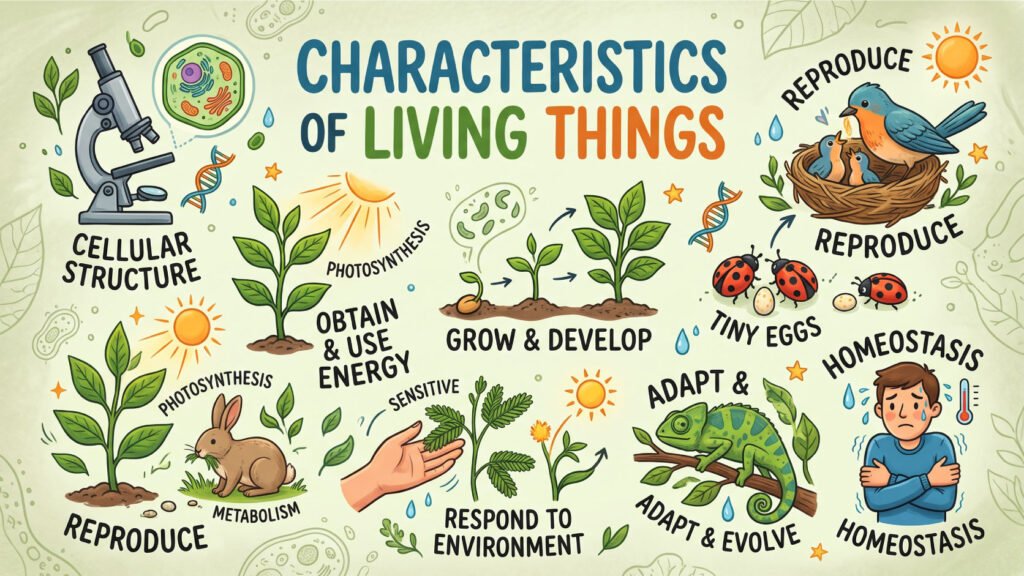
In this article, we will explore seven important characteristics of living things: cellular organization, metabolism, homeostasis, growth and development, response to stimuli, reproduction and heredity, and adaptation and evolution. Understanding these characteristics provides a foundation for studying biology, ecology, genetics, anatomy, and other life sciences.
What Are the Characteristics of Living Things?
The characteristics of living things are the fundamental biological properties and processes shared by organisms. These features help scientists distinguish living organisms from nonliving objects.
All known cellular organisms are composed of one or more cells. They also maintain organized structures, process energy and materials, regulate internal conditions, respond to environmental changes, and possess hereditary information.
The seven characteristics discussed in this article are:
- Cellular Organization
- Metabolism and Energy Processing
- Homeostasis and Regulation
- Growth and Development
- Response to Stimuli
- Reproduction and Heredity
- Adaptation and Evolution
Together, these characteristics provide a useful framework for understanding life.
1. Cellular Organization
Cellular organization is one of the most fundamental characteristics of living organisms. All known living organisms are made up of one or more cells.
A cell is the smallest structural and functional unit of life. It is capable of performing essential biological activities, including metabolism, maintaining internal conditions, processing information, and responding to its environment.
Living organisms are classified into two major groups based on the number of cells they contain.
Unicellular Organisms
Unicellular organisms consist of a single cell that performs all the functions necessary for survival.
Examples include:
- Bacteria: Microscopic prokaryotic organisms found in soil, water, and living bodies.
- Amoeba: A single-celled eukaryotic organism that moves using temporary extensions called pseudopodia.
- Paramecium: A unicellular organism that uses tiny hair-like structures called cilia for movement.
- Yeast: A unicellular fungus commonly used in baking and fermentation.
Although unicellular organisms contain only one cell, that cell performs complex activities such as obtaining nutrients, producing energy, removing wastes, and reproducing.
Multicellular Organisms
Multicellular organisms contain many cells that often become specialized for particular functions.
Examples include humans, dogs, birds, fish, trees, and flowering plants.
In complex multicellular organisms, biological organization generally follows this hierarchy:
Cells → Tissues → Organs → Organ Systems → Organism
For example, in humans, muscle cells form muscle tissue. Different tissues work together to form the heart, and the heart functions as part of the cardiovascular system.
This organization allows different body parts to perform specialized tasks while maintaining the survival of the entire organism.
Why is cellular organization important?
Cells provide the structural framework for life. They contain genetic information, carry out chemical reactions, maintain internal conditions, and perform the activities required for biological survival.
2. Metabolism and Energy Processing
Metabolism refers to the complete set of chemical reactions that occur within an organism or its cells. These reactions allow living organisms to obtain, transform, store, and use energy and materials.
Every living cell requires energy to perform essential activities such as growth, repair, movement, transport, and reproduction.
Metabolism includes two major categories of biochemical reactions.
Anabolism
Anabolism refers to metabolic reactions that build complex molecules from simpler substances. These reactions generally require an input of energy.
Examples include:
- Protein synthesis from amino acids.
- Formation of glycogen from glucose.
- Production of carbohydrates during photosynthesis.
- Synthesis of new cellular components during growth.
Anabolic reactions are essential for building and maintaining cellular structures.
Catabolism
Catabolism refers to metabolic reactions that break down complex molecules into simpler substances. These reactions often release energy that cells can capture and use.
Examples include:
- Breakdown of glucose during cellular respiration.
- Digestion of proteins into amino acids.
- Breakdown of stored fats into fatty acids and other products.
How Do Living Organisms Obtain Energy?
Living organisms obtain energy through different biological processes.
Photosynthesis: Plants, algae, and certain bacteria capture light energy and convert it into chemical energy. In oxygen-producing photosynthesis, carbon dioxide and water are used to produce organic molecules, with oxygen released as a byproduct.
Cellular respiration: Many organisms use cellular respiration to extract energy from organic molecules. Aerobic cellular respiration uses oxygen and transfers energy into ATP, the primary energy currency of cells.
ATP (Adenosine Triphosphate): ATP provides readily usable chemical energy for numerous cellular processes, including active transport, muscle contraction, and biosynthesis.
Importantly, plants also perform cellular respiration. Photosynthesis and respiration are different processes, and plants use both.
Why is metabolism important?
Without metabolic reactions, cells cannot obtain and use the energy and materials needed to maintain their structures, perform biological functions, and sustain life.
3. Homeostasis and Regulation
Homeostasis is the ability of an organism to regulate its internal environment within suitable limits despite changes in external conditions.
Living organisms require relatively stable internal conditions for their cells and biochemical reactions to function properly.
Examples of important regulated conditions include:
- Body temperature.
- Blood glucose concentration.
- Blood pH.
- Water and electrolyte balance.
- Oxygen and carbon dioxide levels.
Examples of Homeostasis in Humans
1. Body Temperature Regulation
The human body maintains its core temperature within a relatively narrow range under normal conditions.
When body temperature increases, sweating and increased blood flow to the skin help release heat.
When body temperature decreases, shivering generates heat through involuntary muscle contractions, while reduced blood flow to the skin helps conserve heat.
2. Blood Glucose Regulation
The pancreas helps regulate blood glucose levels through hormones such as insulin and glucagon.
- Insulin promotes glucose uptake by certain tissues and supports glucose storage, helping lower blood glucose.
- Glucagon promotes processes that increase blood glucose, particularly when levels are low.
Together, these hormones help maintain glucose balance.
3. Water Balance
The kidneys regulate water and electrolyte balance by adjusting the composition and volume of urine.
The hormone antidiuretic hormone (ADH), also called vasopressin, helps regulate water reabsorption in the kidneys.
Negative Feedback Mechanism
Many homeostatic processes operate through negative feedback.
Negative feedback occurs when a change in a regulated condition triggers responses that oppose the original change.
For example, when blood glucose rises after a meal, insulin secretion increases. As blood glucose decreases toward its regulated range, insulin secretion generally declines.
Why is homeostasis important?
Homeostasis helps maintain conditions required for normal cellular activity. Without effective regulation, important biological processes may become disrupted.
4. Growth and Development
Growth and development are essential characteristics of living organisms. They involve changes in an organism’s size, cellular structures, functions, and biological organization throughout its life cycle.
Although growth and development are related, they do not mean exactly the same thing.
Growth
Growth refers to an increase in size, mass, or cellular material.
In multicellular organisms, growth commonly occurs through:
- An increase in cell number through cell division.
- An increase in cell size.
- The accumulation of cellular materials.
For example, a young human grows as cells divide, enlarge, and contribute to the development of different tissues and organs.
Plants grow through cell division and expansion in specialized regions called meristems.
Development
Development refers to the progressive changes an organism undergoes throughout its life cycle.
It includes cellular differentiation, tissue formation, maturation, and changes in biological function.
For example, a fertilized human egg develops through repeated cell divisions, cellular differentiation, and the formation of tissues and organs.
Examples of Growth and Development
Humans: A baby develops into a child, adolescent, and adult through coordinated physical and physiological changes.
Butterflies: A butterfly undergoes complete metamorphosis through four stages: egg, larva, pupa, and adult.
Flowering plants: A seed germinates, develops roots and shoots, matures, and may eventually produce flowers and seeds.
Why are growth and development important?
Growth increases the size or cellular material of an organism, while development establishes the structures and functions needed at different stages of its life cycle.
5. Response to Stimuli
All living organisms can detect and respond to changes in their internal or external environments. These changes are called stimuli.
A stimulus may be physical, chemical, or biological.
Examples include:
- Light.
- Temperature.
- Sound.
- Touch.
- Gravity.
- Chemicals.
- Changes in water availability.
The ability to detect and respond to stimuli helps organisms interact with their surroundings and maintain appropriate biological conditions.
Examples of Responses to Stimuli
1. Plants Responding to Light
Phototropism is the growth response of a plant toward or away from light.
For example, the stems of many plants bend toward a light source, helping their leaves receive more light for photosynthesis.
2. Sensitive Plants Responding to Touch
The sensitive plant (Mimosa pudica) folds its leaflets when touched. This response involves rapid changes in water pressure within specialized cells.
3. Bacteria Responding to Chemicals
Some bacteria exhibit chemotaxis, a movement response toward or away from chemical substances.
This behavior can help bacteria move toward favorable nutrients or away from harmful conditions.
4. Humans Responding to Heat
When a person touches a dangerously hot surface, sensory receptors detect the stimulus. Neural pathways activate muscles that withdraw the hand.
This protective response is known as a withdrawal reflex.
Why is response to stimuli important?
Responses to environmental changes help organisms find resources, avoid harmful conditions, regulate internal functions, and improve their chances of survival and reproduction.
6. Reproduction and Heredity
Reproduction is the biological process through which organisms produce new individuals. It allows genetic information to pass from one generation to the next.
Living organisms reproduce through two major mechanisms: asexual reproduction and sexual reproduction.
Asexual Reproduction
Asexual reproduction involves the production of offspring from a single parent without the fusion of gametes.
In many cases, offspring are genetically very similar to the parent, although mutations can introduce genetic differences.
Examples include:
- Binary fission: Common in bacteria, where one cell divides into two daughter cells.
- Budding: Occurs in organisms such as yeast, where a new individual develops from an outgrowth of the parent.
- Vegetative propagation: Occurs in plants through structures such as runners, bulbs, and tubers.
Sexual Reproduction
Sexual reproduction typically involves the production and fusion of specialized reproductive cells called gametes.
In humans, sperm and egg cells combine during fertilization to form a zygote.
The zygote develops through cell division and differentiation, eventually forming a new organism.
Sexual reproduction contributes to genetic variation through processes such as recombination and the independent assortment of chromosomes.
Role of DNA in Heredity
DNA (deoxyribonucleic acid) contains hereditary information in living cellular organisms.
Genes are specific regions of DNA that contribute to biological functions and inherited characteristics.
During reproduction, genetic information is transmitted to offspring. This allows organisms to inherit characteristics from their parents while also contributing to variation among individuals.
Why are reproduction and heredity important?
Reproduction enables the continuation of populations across generations, while heredity transmits genetic information. Together, these processes provide the basis for biological inheritance and evolution.
An important scientific distinction is that an individual organism does not necessarily need to reproduce to be considered alive. For example, a sterile mule is still a living organism.
7. Adaptation and Evolution
Adaptation and evolution explain how populations of living organisms change over generations and become suited to their environments.
An adaptation is an inherited characteristic that improves an organism’s ability to survive and reproduce in a particular environment.
Evolution is the change in heritable characteristics of populations across successive generations.
Examples of Biological Adaptations
1. Polar Bear Adaptations
Polar bears (Ursus maritimus) possess several characteristics that help them survive in Arctic environments.
These include:
- Thick fur that provides insulation.
- A substantial layer of body fat that reduces heat loss.
- Large paws that help distribute body weight over snow and ice.
- Dark skin beneath their fur, which absorbs solar radiation.
These characteristics contribute to survival in cold environments.
2. Cactus Adaptations
Cacti are adapted to dry environments.
Important adaptations include:
- Leaves modified into spines in many species.
- Thick stems that store water.
- A waxy outer surface that helps reduce water loss.
- Extensive or specialized root systems that help absorb available water.
3. Camouflage in Animals
Some animals have body colors and patterns that make them less visible to predators or prey.
For example, the Arctic hare changes its coat color seasonally in many populations, providing camouflage against changing backgrounds.
How Does Evolution Occur?
Evolution occurs through processes that change the genetic composition of populations over generations.
Important mechanisms include:
- Natural selection: Individuals with heritable traits that improve reproductive success in a particular environment tend to leave more offspring.
- Mutation: Changes in DNA sequences can introduce new genetic variations.
- Genetic drift: Random changes in allele frequencies, particularly influential in small populations.
- Gene flow: The movement of genetic material between populations through migration and reproduction.
Natural selection is one of the major mechanisms responsible for evolutionary adaptation.
Why are adaptation and evolution important?
Evolution explains the diversity of life, the shared ancestry of organisms, and how populations change in response to environmental conditions over many generations.
Importantly, individual organisms do not evolve genetically during their lifetimes in the population-level biological sense. Evolution describes changes in populations across generations.
Summary Table: 7 Characteristics of Living Things
| Characteristic | Scientific meaning | Example |
|---|---|---|
| Cellular organization | Life consists of one or more cells | Bacteria and humans |
| Metabolism | Chemical reactions that process energy and materials | Cellular respiration |
| Homeostasis | Regulation of internal conditions | Human temperature regulation |
| Growth and development | Increase in size and progressive biological changes | Seed developing into a plant |
| Response to stimuli | Detection and reaction to environmental changes | Plant bending toward light |
| Reproduction and heredity | Production of offspring and transmission of genetic information | Bacterial binary fission |
| Adaptation and evolution | Inherited traits and population changes across generations | Cactus adaptations to dry environments |
Living Things vs. Nonliving Things
Living and nonliving things can sometimes appear similar because both may move, change shape, or increase in size. However, living organisms possess an integrated set of biological properties that nonliving objects do not.
| Feature | Living things | Nonliving things |
|---|---|---|
| Cellular structure | Composed of cells | Not composed of living cells |
| Metabolism | Perform biological metabolic reactions | Do not perform their own metabolism |
| Homeostasis | Regulate internal conditions | Do not maintain biological homeostasis |
| Growth | Grow through biological processes | May increase in size through external processes |
| Response to stimuli | Produce biological responses | May respond physically or chemically |
| Reproduction | Organisms have reproductive processes at the species or population level | Do not reproduce biologically |
| Evolution | Populations evolve through heritable changes | Do not undergo biological evolution |
For example, a crystal can increase in size as additional molecules attach to its surface, but this is not biological growth. Similarly, a fire can spread and consume fuel, but it does not have cellular organization or biological heredity.
These differences demonstrate why scientists consider multiple characteristics together when identifying life.
Are Viruses Living or Nonliving?
Viruses are biological entities that challenge the distinction between living and nonliving systems.
A virus typically consists of genetic material, either DNA or RNA, enclosed in a protein coat called a capsid. Some viruses also possess an outer lipid envelope.
Viruses contain hereditary information and can evolve through genetic variation and natural selection. They can also reproduce, but only by using the molecular machinery of host cells.
Unlike cellular organisms, viruses do not independently carry out metabolism or maintain homeostasis.
Because of these limitations, viruses are generally not classified as living organisms under standard cellular definitions of life.
However, their ability to evolve and reproduce within host cells makes them important subjects in biology and evolutionary science.
Why Are the Characteristics of Living Things Important in Biology?
Understanding the characteristics of living things provides the foundation for studying many areas of biology.
These properties help scientists:
- Identify and distinguish living organisms from nonliving matter.
- Understand how cells function and maintain life.
- Explain how organisms obtain and use energy.
- Study growth, development, and reproduction.
- Investigate how organisms interact with their environments.
- Understand heredity and genetic variation.
- Explain evolution and the diversity of life on Earth.
Knowledge of these characteristics is especially important for students studying cell biology, genetics, microbiology, anatomy, physiology, and ecology.
Frequently Asked Questions (FAQs)
1. What are the seven characteristics of living things?
A useful seven-feature framework includes cellular organization, metabolism, homeostasis, growth and development, response to stimuli, reproduction and heredity, and adaptation and evolution.
2. What is the most important characteristic of living things?
Cellular organization is one of the most fundamental characteristics because all known living organisms consist of one or more cells. However, no single feature independently defines all aspects of life.
3. Are all living organisms made of cells?
Yes. All known living organisms are cellular. Some consist of a single cell, while others contain many specialized cells.
4. Do plants perform cellular respiration?
Yes. Plants perform cellular respiration to release usable energy from organic molecules. They also perform photosynthesis when suitable light is available.
5. Can living organisms survive without reproduction?
Yes. Individual organisms do not need to reproduce to remain alive. Sterile animals, such as mules, demonstrate this clearly.
6. Why are viruses not generally considered living organisms?
Viruses lack cellular organization and cannot independently perform metabolism or reproduce without a host cell. Therefore, they are generally classified as noncellular infectious agents rather than living organisms.
7. What is the difference between growth and development?
Growth refers to an increase in size, mass, or cellular material. Development involves progressive changes in an organism’s structure, organization, and function throughout its life cycle.
8. What is the difference between adaptation and evolution?
Adaptation refers to inherited characteristics that improve reproductive success in a particular environment. Evolution refers to changes in heritable characteristics of populations across generations.
9. Do all living organisms need oxygen?
No. Many organisms require oxygen for aerobic respiration, but some organisms can obtain energy through anaerobic respiration or fermentation. Oxygen is not essential for every form of life.
10. What is the difference between living and nonliving things?
Living organisms have cellular organization and carry out integrated biological processes such as metabolism, regulation, growth, and response to stimuli. Nonliving objects do not perform these processes as organisms.
Conclusion
The seven characteristics of living things provide a practical framework for understanding what makes organisms biologically alive. From cellular organization and metabolism to homeostasis, reproduction, and evolution, these features explain how living systems function, maintain themselves, and continue across generations.
Although bacteria, plants, animals, fungi, and other organisms differ greatly in appearance and complexity, they share fundamental biological principles. Studying these characteristics helps students develop a deeper understanding of life and provides a strong foundation for exploring more advanced topics in biology.
As you continue learning biology, remember that life is not defined by a single feature. It is recognized through the combination of interconnected structures and biological processes.
Scientific References and Further Reading
The following educational and scientific resources support the concepts discussed in this article:
- OpenStax. Biology 2e – Themes and Concepts of Biology.
https://openstax.org/books/biology-2e/pages/1-2-themes-and-concepts-of-biology - OpenStax. Biology – Themes and Concepts of Biology.
https://openstax.org/books/biology/pages/1-2-themes-and-concepts-of-biology - NASA Science. What Are the Characteristics of Life?
https://science.nasa.gov/astrobiology/learning-resources/alp/characteristics-of-life/ - Biology LibreTexts. Shared Traits of All Living Things.
https://bio.libretexts.org/Bookshelves/Human_Biology/Human_Biology_%28Wakim_and_Grewal%29/02%3A_Introduction_to_Human_Biology/2.2%3A_Shared_Traits_of_All_Living_Things - OpenStax. Concepts of Biology – Themes and Concepts of Biology.
https://openstax.org/books/concepts-biology/pages/1-1-themes-and-concepts-of-biology

[…] important characteristics are cellular organization, metabolism, growth and development, reproduction, and response to stimuli. Homeostasis and […]